
Movies
The Last Golden Age Legend: Remembering Eva Marie Saint, the Oscar-Winning Visionary of ‘On the Waterfront’ and ‘North by Northwest,’ at 102
Oct
1. The Farewell to a Legend: Mourning the Oldest Living Oscar Winner and the Last Titan of the Golden Age
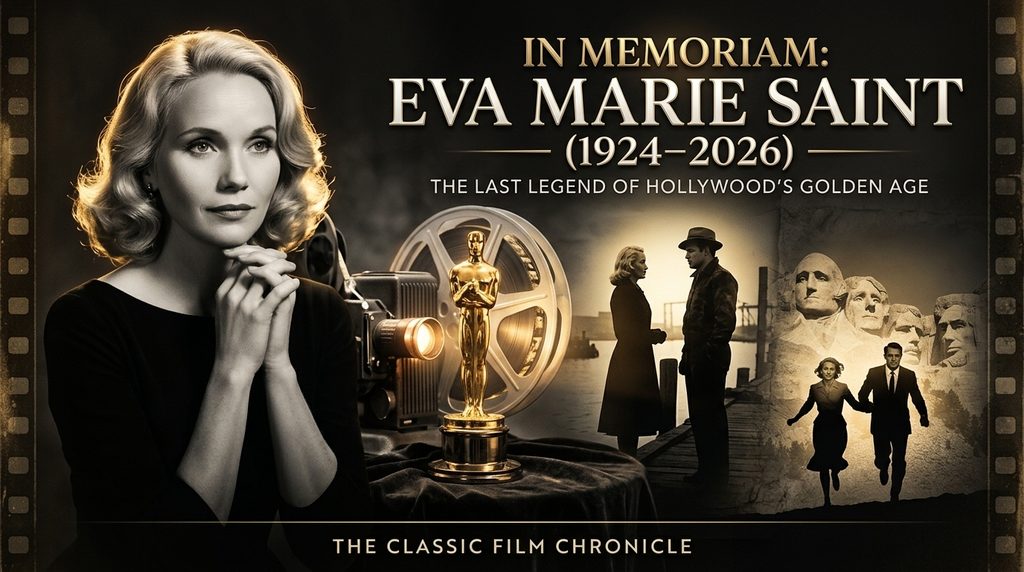
The final curtain has gently descended upon one of the most majestic, dignified, and transformative chapters in the history of world cinema. On Tuesday, October 6, 2026, representatives confirmed that Academy Award-winning actress Eva Marie Saint passed away peacefully of natural causes at her residence in Los Angeles, surrounded by her loving family and lifelong admirers, at the extraordinary age of 102. With her passing, the global cinematic community does not merely mourn the loss of a beloved performer; it marks the symbolic, heartbreaking conclusion of an entire era. Saint was universally revered as the oldest living recipient of an Academy Award and stood as one of the very last surviving titans who walked, worked, and triumphed during the legendary Golden Age of Hollywood.
Born on July 4, 1924, in Newark, New Jersey, Saint entered the theatrical landscape during a period of monumental cultural evolution. While many of her mid-century peers succumbed to the destructive machinery of the old studio contract system—falling prey to aggressive typecasting, sensationalized tabloid scandals, or premature artistic retirement—Saint navigated the treacherous currents of Hollywood with an uncompromising moral compass, peerless professionalism, and radiant grace. Over a working career that spanned nearly eight decades across stage, live television broadcasts, and major motion pictures, she demonstrated an artistic longevity that remains virtually unmatched in the annals of screen entertainment.
The public and institutional response to Saint’s passing has reverberated across every major artistic institution in the world. From the Academy of Motion Picture Arts and Sciences to Lincoln Center, tributes have poured in celebrating an artist whose work permanently elevated the medium. Tributes from fellow Oscar winners, film historians, and generations of actors have highlighted not only her incandescent screen presence, but her rare status as a working mother who openly prioritized domestic sanity and creative integrity over relentless industry ambition. In an industry notoriously prone to discarding women as they age, Saint defied every systemic barrier, capturing major awards in her thirties, maintaining a prolific television presence in her sixties, and delivering commanding feature-film performances well into her nineties.
To reflect upon Eva Marie Saint’s legacy is to survey the birth of modern naturalistic acting. When she stepped onto soundstages in the early 1950s, American cinema was breaking away from the melodramatic, theatrical elocution of the 1930s and 1940s, pivoting toward the psychological realism and vulnerable method acting championed by the Actors Studio. Saint was not merely a passive beneficiary of this movement; she was its radiant, feminine pioneer. Her luminous blue eyes, hushed vocal resonance, and astonishing emotional transparency introduced audiences to female characters who were intellectually curious, morally autonomous, and emotionally authentic, setting a standard that continues to inspire modern cinematic storytelling.
2. A Miraculous Debut: Marlon Brando, Elia Kazan, and the Historic Oscar Triumph of ‘On the Waterfront’
Very few actors in the history of cinema have engineered a big-screen debut as historically seismic as Eva Marie Saint in Elia Kazan’s 1954 masterpiece, On the Waterfront. Prior to 1954, Saint had established a formidable reputation in the rigorous trenches of early live television drama in New York and had captured the prestigious Drama Critics’ Circle Award for her performance in Horton Foote’s Broadway production of The Trip to Bountiful opposite Lillian Gish. Yet, she had never appeared in a commercial motion picture. When director Elia Kazan was searching for the female lead to anchor his gritty, black-and-white exposé of mob-controlled dockworkers on the Hoboken, New Jersey piers, he sought an actress who possessed an unblemished, spiritual innocence that could believably crack through the hardened, defensive shell of longshoreman Terry Malloy, portrayed by Marlon Brando.
Kazan discovered that exact quality in Saint. Cast as Edie Doyle—a devout Catholic convent schoolgirl whose brother’s brutal murder at the hands of corrupt union bosses sets the film’s tragic moral machinery in motion—Saint was thrust into the deepest end of cinematic performance, sharing intimate two-shots with Brando at the absolute summit of his generational powers. Rather than being intimidated by Brando’s volatile, unscripted intensity, Saint met him with an astonishing, quiet authority. The chemistry between the two gave rise to one of the most celebrated improvisational sequences in movie history: the iconic “glove scene.” When Saint accidentally dropped her white wool glove on the pavement during an emotionally charged stroll through an urban park, Brando instinctively picked it up and, instead of handing it back, began caressing it and absentmindedly sliding his own rough hand inside. Rather than breaking character, Saint reacted with a delicate mixture of bashfulness, curiosity, and erotic charge, creating an indelible moment of cinematic poetry that Kazan kept in the final cut.
The film became a critical and commercial phenomenon, sweeping eight Academy Awards at the 27th Oscars ceremony, including Best Picture, Best Director for Kazan, and Best Actor for Brando. Saint herself achieved an extraordinary historical milestone, capturing the Academy Award for Best Supporting Actress for her very first film performance. Her acceptance of the Oscar remains one of the most beloved moments in Oscar lore: nine months pregnant with her first child, son Darrell (whom she shared with her husband, director Jeffrey Hayden), Saint took the stage in a radiant maternity gown. Her acceptance speech was short, breathless, and radiantly joyful, famously exclaiming to the crowd that she might give birth right there on the stage before thanking Kazan and her costars for believing in a newcomer.
On the Waterfront permanently redefined what a leading lady could accomplish in American drama. Edie Doyle was not a passive damsel awaiting rescue, nor was she a disposable romantic reward. She was the moral spine of the entire narrative—the relentless conscience that forced Terry Malloy to confront his complicity in systemic evil and ultimately testify before the waterfront crime commission. Saint’s performance proved that delicacy was not weakness; that a soft, trembling voice could speak with the thunderous moral weight of a prophet.
3. The Definitive Hitchcock Blonde: Reinventing the Femme Fatale Opposite Cary Grant in ‘North by Northwest’
Following her triumphant debut, Hollywood studios initially attempted to pigeonhole Saint into demure, saintly domestic roles. She delivered nuanced, compelling work in films like That Certain Feeling (1956) with Bob Hope, Fred Zinnemann’s gritty drug-addiction drama A Hatful of Rain (1957), and the expansive Civil War epic Raintree County (1957) alongside Elizabeth Taylor and Montgomery Clift. However, it was the Master of Suspense himself, Alfred Hitchcock, who recognized that beneath Saint’s angelic, sweet exterior lay an untapped reserve of razor-sharp sensuality, worldly wit, and cold, dangerous mystery.
In 1959, Hitchcock cast Saint opposite the epitome of debonair sophistication, Cary Grant, in the seminal spy thriller North by Northwest. To transform Saint into Eve Kendall—a duplicitous industrial designer who is secretly working as an undercover American intelligence agent while embedded as the mistress of a villainous foreign spy—Hitchcock executed a total aesthetic and tonal reinvention. In famous production lore that Saint frequently recalled with affectionate humor, Hitchcock dismissed the wardrobe selected by MGM’s studio department, took Saint personally on an opulent shopping spree at Bergdorf Goodman in Manhattan, and hand-selected her sophisticated, tailored wardrobe, including the legendary black silk dress embroidered with crimson roses. Hitchcock instructed her to cut her long blonde hair into a sleek, razor-sharp bob and coached her to lower her natural speaking voice several octaves to project an alluring, husky gravitas.
The resulting character of Eve Kendall stands as the most sophisticated, self-possessed “Hitchcock blonde” in the director’s entire canon. From her electrifying introductory dialogue with Grant aboard the 20th Century Limited dining car—where she coolly informs him, “I never discuss sex on an empty stomach”—to the climactic, vertigo-inducing pursuit across the granite faces of Mount Rushmore, Saint subverted every existing trope of the cinematic femme fatale. Unlike the victimized or neurotic blonde heroines that populated other Hitchcock classics, Eve Kendall was completely in control of her agency, her sexuality, and her mission, utilizing her wits to outmaneuver international assassins while risking her life for her country.
Significantly, Saint’s personal recollections of working with Alfred Hitchcock provided a vital historical counterpoint to the darker, more fraught accounts shared by actresses like Tippi Hedren. Throughout her life, Saint steadfastly defended Hitchcock as an impeccable gentleman, a generous creative collaborator, and a warm mentor who treated her with profound courtesy and respect. Their creative alignment produced a masterpiece that remains the timeless benchmark of cinematic escapism, proving that Saint could transition from gritty social realism to sparkling Technicolor espionage without sacrificing a single drop of her psychological authenticity.
4. Six Decades of Grace: Television Mastery, Broadway Triumphs, and Her Superheroic Renaissance
Following the international triumph of North by Northwest, Saint continued to build an extraordinarily diverse filmography throughout the 1960s, starring alongside Paul Newman in Otto Preminger’s sprawling historical epic Exodus (1960), sharing the screen with Elizabeth Taylor and Richard Burton in Vincente Minnelli’s The Sandpiper (1965), and taking part in John Frankenheimer’s high-octane Formula One spectacle Grand Prix (1966). Yet, as the 1970s arrived and the film industry underwent chaotic industrial changes, Saint consciously stepped back from the Hollywood studio machine to focus on raising her two children alongside husband Jeffrey Hayden, refusing to allow the relentless demands of movie stardom to fracture her domestic sanctuary.
Rather than retiring, Saint redirected her boundless creative energy toward the burgeoning medium of prestige television and the classical stage. She became an indispensable presence on American television screens across three consecutive decades, starring in landmark miniseries and television movies such as How the West Was Won (1977), A Year in the Life (1986), and I’ll Be Home for Christmas (1988). A new generation of television viewers fell in love with her comedic warmth when she took on the recurring role of Virginia Clayton—the sharp, loving mother to Cybill Shepherd’s Maddie Hayes—on the hit 1980s detective comedy Moonlighting. In 1990, Saint achieved top television honors, winning the Primetime Emmy Award for Outstanding Supporting Actress in a Miniseries or Special for her commanding turn in the NBC miniseries People Like Us, cementing her status as an elite performer across all visual mediums.
The dawn of the twenty-first century witnessed a glorious, affectionate renaissance in Saint’s film career. In 2005, she delivered a touching, grounded performance in Wayne Wang’s family classic Because of Winn-Dixie and collaborated with German auteur Wim Wenders in the arthouse drama Don’t Come Knocking. In 2006, at the age of eighty-two, Saint endeared herself to millions of comic-book and superhero fans worldwide when director Bryan Singer cast her as Martha Kent—the loving adoptive human mother of the Man of Steel—in the big-budget blockbuster Superman Returns. Her quiet, tender scenes on the Kent farm alongside Brandon Routh brought an authentic gravitas and classical Golden Age warmth to the modern superhero landscape.
Saint’s artistic curiosity never diminished with age. In 2012, at the age of eighty-eight, she ventured into high-end animation, lending her regal, soothing vocal talents to the beloved Nickelodeon fantasy series The Legend of Korra, voicing an elderly Katara across multiple seasons to the delight of millions of younger viewers. In 2014, at the milestone age of ninety, she appeared on the silver screen once more in Akiva Goldsman’s romantic adaptation of Winter’s Tale, acting opposite Colin Farrell. Her willingness to embrace new genres, emerging filmmakers, and changing artistic platforms proved that her dedication was never tethered to vanity; she was, first, last, and always, a dedicated working actress in service of the storytelling craft.
5. A Century of Wisdom: Love, Longevity, and the Eternal Legacy of Hollywood’s Most Principled Star
In examining the long, miraculous life of Eva Marie Saint, one is struck by an inescapable reality: her greatest triumph was not her Oscar statuette, her Hitchcock collaboration, or her star on the Hollywood Walk of Fame. Her supreme triumph was how she lived her life. In an industry famous for disposable relationships, narcissistic excesses, and personal tragedies, Saint crafted a personal narrative that was defined by enduring fidelity, quiet dignity, and profound emotional balance.
Central to her remarkable longevity was her legendary marriage to television director and producer Jeffrey Hayden. The two met in New York in the late 1940s when both were young, struggling theatrical hopefuls, and married in 1951. Their union endured for an astonishing sixty-five years until Hayden’s passing in December 2016 at the age of ninety. Throughout their six-and-a-half decades together, the couple served as the golden ideal of Hollywood romance. They collaborated on regional theater productions, traveled the world together, raised two children—son Darrell and daughter Laurette—and built an expansive family that eventually encompassed four grandchildren and two great-grandchildren. Saint frequently attributed her career longevity to her husband’s unwavering support and their shared refusal to allow the superficial glitz of Hollywood to enter their home.
Saint’s philosophical perspective on aging remains an inspirational beacon for the modern world. In a culture obsessed with preserving youth through artificial means and terrified of passing years, Saint embraced each decade with open arms and fierce intellectual curiosity. During an unforgettable 2014 retrospective interview with legendary Turner Classic Movies host Robert Osborne to mark her ninetieth birthday, Saint shared an insight that distilled her entire approach to existence: “The longer you live, the smarter you get, because you’ve been around, you’ve seen things, you’ve gone through different emotional experiences in your own life and hopefully you understand things better. And that makes you a better actress. It makes you a better human being.”
As the world bids its final, tearful farewell to Eva Marie Saint at 102, her legacy stands completely unassailable. Whenever film historians lecture on the power of cinematic realism, they will roll the footage of a young Edie Doyle weeping on a Hoboken rooftop with Marlon Brando. Whenever audiences crave the thrilling, sophisticated romance of classic cinema, they will board the train to Chicago alongside Eve Kendall and Cary Grant. Eva Marie Saint did not merely survive a century of cinema; she graced it with an incandescent light that time can never extinguish. The Golden Age of Hollywood may have drawn its final breath, but through her enduring art, Eva Marie Saint will live forever.
From: BHGiftnest

