
Movies
Cinema Under Siege: Why Guillermo del Toro’s Fiery Defense of Tom Cruise’s $180 Million Flop ‘Digger’ Exposes Hollywood’s Broken Box Office Culture
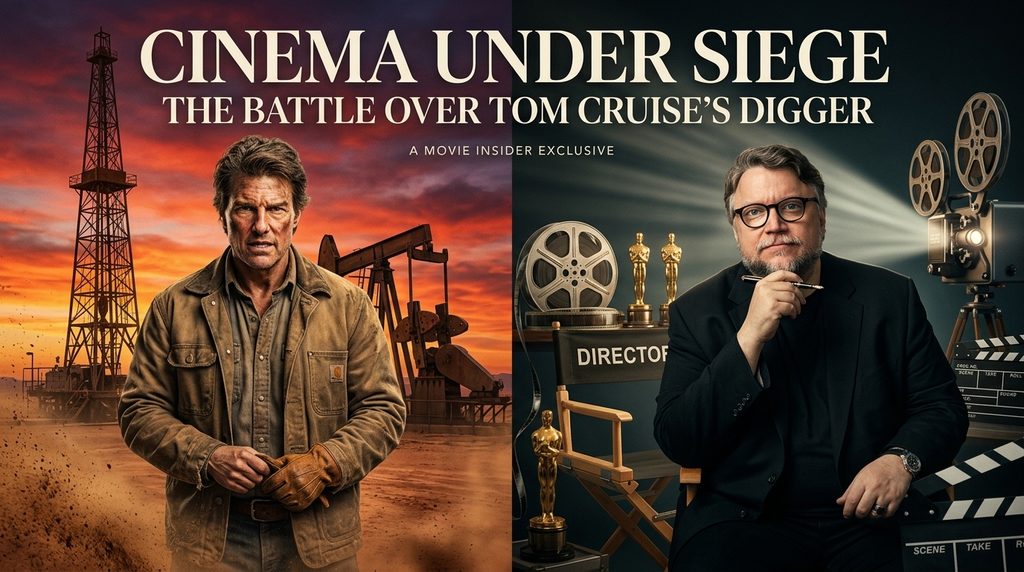
Oct
1. The Box Office Meltdown: How Tom Cruise’s $180 Million Gamble Landed in Financial Peril
For more than four decades, the name Tom Cruise has functioned as the gold standard of cinematic invulnerability. In an era where franchise intellectual properties, comic-book algorithms, and digital streaming platforms systematically eradicated the traditional Hollywood movie star, Tom Cruise stood alone as the defiant savior of the theatrical experience. Following the historic billion-dollar triumph of Top Gun: Maverick in 2022 and his relentless physical acrobatics across the Mission: Impossible franchise, the global industry operated under the unassailable assumption that any project stamped with Tom Cruise’s marquee charisma was pre-ordained for commercial dominance. That myth of commercial infallibility suffered a staggering, catastrophic blow over the weekend with the theatrical release of Digger.
Produced with a staggering production budget estimated between $160 million and $180 million by Warner Bros. Pictures, Digger represented one of the most daring, high-stakes artistic collaborations in recent Hollywood history. Teaming Tom Cruise with visionary four-time Academy Award-winning Mexican auteur Alejandro González Iñárritu (Birdman, The Revenant), the production was engineered not as a cookie-cutter popcorn diversion, but as an expansive, sprawling satirical drama. In the film, Tom Cruise underwent a radical, transformative physical and psychological metamorphosis, shedding his heroic stuntman persona to portray an aging, ruthless, megalomaniacal oil tycoon grappling with ecological devastation, late-stage capitalism, and his own unraveling sanity in the sun-baked plains of the American Southwest. Anticipation among awards prognosticators was incandescent; early festival chatter positioned the project as Tom Cruise’s ultimate bid for the elusive Best Actor Oscar that has slipped through his fingers for forty years.
Yet, when the domestic box office numbers were finalized on Sunday afternoon, the reality was a devastating commercial bloodbath. Digger collapsed in its North American debut, clawing together a mere $8 million across more than 3,300 theaters. Bolstered by an equally tepid $12 million from international territories, the film’s worldwide launch settled at a dismal $20 million. It marked the lowest opening weekend for a wide-release Tom Cruise vehicle in nineteen years, trailing far behind contemporary genre holdovers and landing at an embarrassing fifth place on domestic charts. With trade analysts calculating that Digger must gross upwards of $300 million globally simply to break even after global marketing expenditures, the financial prognosis is undeniably bleak.
The immediate reaction across trade publications and social media ecosystems was swift, vicious, and saturated with unmistakable schadenfreude. Headline after headline seized upon the film’s polarizing “C+” CinemaScore, painting the production as an unchecked vanity project and an emblem of directorial indulgence. Pundits openly questioned why a studio would greenlight an esoteric, absurdist arthouse satire with an action-blockbuster budget in an unpredictable theatrical climate. What could have been an earnest industry conversation regarding the financial realities of adult-oriented original cinema rapidly degenerated into algorithmic clickbait, with digital commentators celebrating the apparent humbling of cinema’s most tenacious ambassador.
2. Guillermo del Toro’s Fiery Counter-Offensive: Slamming “Petty” Media Coverage and Championing Cinema Scale
As the media narrative threatened to reduce years of meticulous cinematic craftsmanship into a punchline about opening-weekend spreadsheets, one of the most revered and formidable voices in modern cinema entered the arena to wage war against the prevailing discourse. Three-time Academy Award winner Guillermo del Toro (The Shape of Water, Pan’s Labyrinth, Pinocchio) took to social media to launch an impassioned, blistering defense of Iñárritu’s film, aiming his ire directly at what he characterized as the cheap, superficial cruelty of modern entertainment journalism.
Del Toro singled out an especially cynical industry headline that suggested audiences should bypass the theater entirely because “the theater experience won’t change your mind on Digger, and the laughs that are there still will be when it hits HBO Max.” Responding with characteristic eloquence and volcanic moral outrage, del Toro branded the sentiment as thoroughly “petty,” regardless of whether an individual viewer personally connected with the narrative choices of the film. “And, yes, I do,” del Toro forcefully clarified regarding his personal admiration for the picture. “The film delivers in scale, ambition, and reach at a theatrical screen level. It is daring, bold, and Cinematically complex. It is decidedly a Theatrical experience.”
Del Toro’s defense struck at the fundamental rot plaguing modern cultural commentary: the dangerous conflation of opening-weekend box office receipts with artistic value. The Mexican maestro argued that reducing a complex, multi-layered visual achievement to its immediate commercial return encourages a cowardly studio culture that refuses to fund anything beyond risk-averse franchise sequels and algorithmic nostalgia bait. By emphasizing that Digger was conceived, framed, lit, and paced specifically for the communal darkness of an auditorium—leveraging IMAX photography, gargantuan practical sets, and intricate sound design—del Toro issued a rallying cry for the preservation of visual scale. He rejected the defeatist notion that any film failing to achieve instant universal consensus should be dismissed as mere fodder for phone screens and home streaming queues.
Furthermore, del Toro underscored the sheer rarity of an A-list movie star using their hard-earned commercial capital to facilitate uncompromising auteur cinema. In an industry where major stars routinely retreat into the safe, sanitized confines of superhero cameos and brand-sponsored action vehicles, Tom Cruise chose to place his reputation on the line alongside Iñárritu, embracing an unsympathetic, grotesque, and tragic role that demanded total psychological vulnerability. For del Toro, attacking an artist for failing while swinging for the cinematic fences represents the ultimate betrayal of film criticism—a toxic mindset that punishes audacity while rewarding corporate mediocrity.
3. The Brotherhood of the “Three Amigos”: Iñárritu, Del Toro, and Cuarón’s Defense of Auteur Filmmaking
Guillermo del Toro’s vocal intervention on behalf of Alejandro González Iñárritu cannot be separated from the extraordinary historical context of their personal and professional alliance. Alongside five-time Academy Award winner Alfonso Cuarón (Gravity, Roma, Children of Men), del Toro and Iñárritu constitute the legendary fraternity affectionately known throughout global cinema as “The Three Amigos.” For over a quarter of a century, these three native Mexican filmmakers have functioned not merely as colleagues, but as an indivisible creative vanguard that transformed the aesthetic landscape of international cinema.
The bond between the trio was forged in the independent trenches of 1990s Mexican cinema, where budgetary constraints required uncompromising ingenuity and mutual reliance. Throughout their ascent to the pinnacle of Hollywood acclaim—a reign that saw them capture five Best Director Oscars between 2013 and 2018—the Three Amigos maintained a sacred tradition of serving as unofficial script doctors, rough-cut editors, and emotional cornerstones for one another’s projects. It is a brotherhood built upon absolute creative candor and unyielding loyalty against the commercial pressures of American studio interference.
Joining del Toro’s defense over the weekend, Alfonso Cuarón took a subtly devastating, historically grounded approach to push back against the critical pile-on. Cuarón published a curated series of historical artifacts: archival contemporary reviews from the initial releases of acknowledged cinematic masterpieces that were initially savaged or misunderstood by critics upon arrival. He juxtaposed the scathing, dismissive reviews that greeted Jonathan Glazer’s Under the Skin (2013), Charles Laughton’s The Night of the Hunter (1955), Ridley Scott’s Blade Runner (1982), and Stanley Kubrick’s 2001: A Space Odyssey (1968) with their current, unanimous standing in the pantheon of world cinema. Without typing a single word of polemic, Cuarón’s historical collage delivered an unmistakable message: the immediate verdict of the opening-weekend critical consensus is frequently myopic, reactionary, and destined to be overturned by the slow, impartial judgment of time.
This unified front demonstrates why the Three Amigos remain the moral conscience of modern cinema. They understand that true artistic progress requires the freedom to fail spectacularly. Iñárritu has never constructed polite, comfortable cinema; his filmography—from the kinetic heartbreak of Amores Perros to the punishing, raw winter survival of The Revenant—is characterized by manic ambition, psychological confrontation, and aesthetic maximalism. When an artist of that caliber collaborates with an icon of Cruise’s discipline, the resulting collision was never going to yield a safe, homogenously pleasing product. In rallying around their brother, del Toro and Cuarón reminded the world that artistic integrity is measured by the courage of the vision, not the convenience of the algorithm.
4. Ahead of Its Time or a Costly Misfire? The Lessons of ‘Blade Runner’ and ‘2001: A Space Odyssey’
The historical parallels invoked by Cuarón demand rigorous critical examination. Is Digger truly a misunderstood masterpiece ahead of its time, or is the defense offered by del Toro a well-intentioned case of fraternal loyalty shielding an undisciplined financial disaster? The history of Hollywood is illuminated by films that were initially rejected by contemporary audiences only to emerge as canonical touchstones for future generations.
When Stanley Kubrick released 2001: A Space Odyssey in April 1968, the initial critical reaction was famously hostile. Influential critics walked out of early screenings; Pauline Kael dismissed it as “trash masquerading as art,” and trade papers questioned why Metro-Goldwyn-Mayer had squandered colossal resources on a glacial, dialogue-sparse meditation on human evolution. Similarly, when Ridley Scott unleashed Blade Runner in the summer of 1982, the neo-noir sci-fi epic bombed at the box office, grossing barely $14 million against a $30 million budget. Audiences expecting the swashbuckling, heroic adventure of Harrison Ford’s Han Solo or Indiana Jones were repulsed by the film’s rain-soaked existential dread, moral ambiguity, and nihilistic pacing. Yet, four decades later, Scott’s vision fundamentally dictates the aesthetic grammar of contemporary science fiction, architecture, and video game design.
Digger occupies a remarkably similar cultural and psychological terrain. The primary driver of the audience backlash appears to be a severe misalignment of marketing expectations. Audiences purchasing tickets to a $180 million Tom Cruise vehicle in October 2026 reasonably anticipated a high-octane, propulsive thrill ride. Instead, Iñárritu delivered a challenging, surrealist deconstruction of American greed—a film featuring protracted sequences of psychological delirium, grotesque satire, and an unsparing, satirical indictment of industrial resource extraction. The “C+” CinemaScore does not necessarily signify an incompetent artistic work; historically, low CinemaScores are frequently awarded to polarizing masterpieces that refuse to provide audiences with comforting narrative closure (as evidenced by low scores for Darren Aronofsky’s mother!, Martin Scorsese’s The Wolf of Wall Street, and David Fincher’s Fight Club).
Furthermore, Cruise’s performance in Digger is precisely the kind of work that rewards retrospective reassessment. Operating far outside his comfort zone, Cruise channels an unhinged, feral intensity that recalls his career-best work in Paul Thomas Anderson’s Magnolia (1999) and Stanley Kubrick’s Eyes Wide Shut (1999). He allows the camera to linger on his aging face, exposing physical vulnerability, psychological decay, and pathetic vanity without vanity or protective vanity lighting. In thirty years, when film scholars examine the twilight era of Cruise’s extraordinary career, Digger will almost certainly stand out as an indispensable anomaly: the moment an aging action king dared to dismantle his own myth on an operatic, multi-million-dollar canvas.
5. The Survival of Theatrical Art in the Age of Streaming: Why Hollywood Needs Tom Cruise to Keep Taking Risks
Beyond the specific financial autopsy of Digger, the controversy surrounding its release exposes an existential crisis threatening the future of cinematic culture. We are currently living through a profound industrial contraction. Media conglomerates, burdened by billions of dollars in streaming-service debt, are ruthlessly purging risk from their release slates. Mid-budget adult dramas have virtually vanished from theatrical distribution, forced into the disposable content conveyor belts of digital streaming apps where they compete for attention against social media feeds and television background noise.
In this precarious environment, the theatrical ecosystem desperately requires idiosyncratic, high-budget originals like Digger to exist. If the lesson Hollywood studios extract from Digger’s failure is that Tom Cruise must only make Top Gun and Mission: Impossible sequels until he is eighty years old, the cinematic art form will suffer an irreparable loss. Cinema cannot survive as a monoculture of intellectual property extensions and corporate franchise maintenance. The medium was built upon the daring of auteurs given the resources to realize idiosyncratic, singular visions on a grand scale. When a studio like Warner Bros. invests $180 million in an original R-rated vision from Alejandro G. Iñárritu, it represents a noble, increasingly rare act of faith in the theatrical medium itself.
Guillermo del Toro’s defense of the film is ultimately a defense of cinema’s right to be difficult, challenging, and uncommercial. The insidious rhetoric that an ambitious film “should just go straight to streaming” is a cultural cancer that trains audiences to view cinematic storytelling as disposable television content. Certain visual compositions, sonic frequencies, and emotional rhythms can only achieve their intended psychological resonance when experienced in a darkened theater alongside strangers, insulated from the distractions of the domestic living room. To celebrate the box office failure of an ambitious theatrical experiment is to cheer for the further erosion of one’s own cultural diet.
As Digger concludes its tumultuous opening chapter and begins the long, difficult march through its international theatrical run, its ultimate legacy remains unwritten. The spreadsheets will record a painful, multi-million-dollar writedown for Warner Bros. Discovery; the tabloids will enjoy their momentary feast upon an uncharacteristic Cruise misfire. But as history has proven time and time again, the ledger books of corporate accountants eventually turn to dust, while the celluloid dreams of fearless artists endure. In daring to fund, shoot, and champion a monumentally ambitious disaster rather than a comfortably safe success, Cruise, Iñárritu, and their vocal defender Guillermo del Toro have reminded us of what cinema was always supposed to be: a wild, dangerous, breathtaking gamble on the human soul.
From: Bhgiftnest

