
Movies
Shedding the Armor of The Rock: Inside Dwayne Johnson’s Shocking Metamorphosis in Benny Safdie’s Lizard Music
Oct
1. The Shock of the New York Set Photos: Dismantling Hollywood’s Most Formidable Silhouette
For more than two decades, the global entertainment industrial complex has been anchored by one of the most instantly recognizable, genetically formidable human silhouettes in modern visual culture: the towering, immaculately sculpted, larger-than-life physique of Dwayne ‘The Rock’ Johnson. Standing six-foot-five, weighing well over two hundred and sixty pounds of dense, vascular muscle, and flashing a trademark mega-watt smile capable of powering a stadium grid, Johnson has reigned as the undisputed titan of twenty-first-century blockbuster cinema. Whether outrunning collapsing tectonic plates in San Andreas, wrestling primeval beasts in Rampage, commandeering armored supercars in Fast & Furious, or anchoring billion-dollar franchises like Jumanji, the visual promise of a Dwayne Johnson vehicle was absolute and unyielding. The hero would remain indestructible; the biceps would remain colossal; and the personal brand of ‘The Rock’ would endure without a scratch.
Yet on a chilly Tuesday morning along the rain-dampened cobblestones of downtown Manhattan, that entire multi-billion-dollar visual architecture was shattered in a single, jaw-dropping instant.
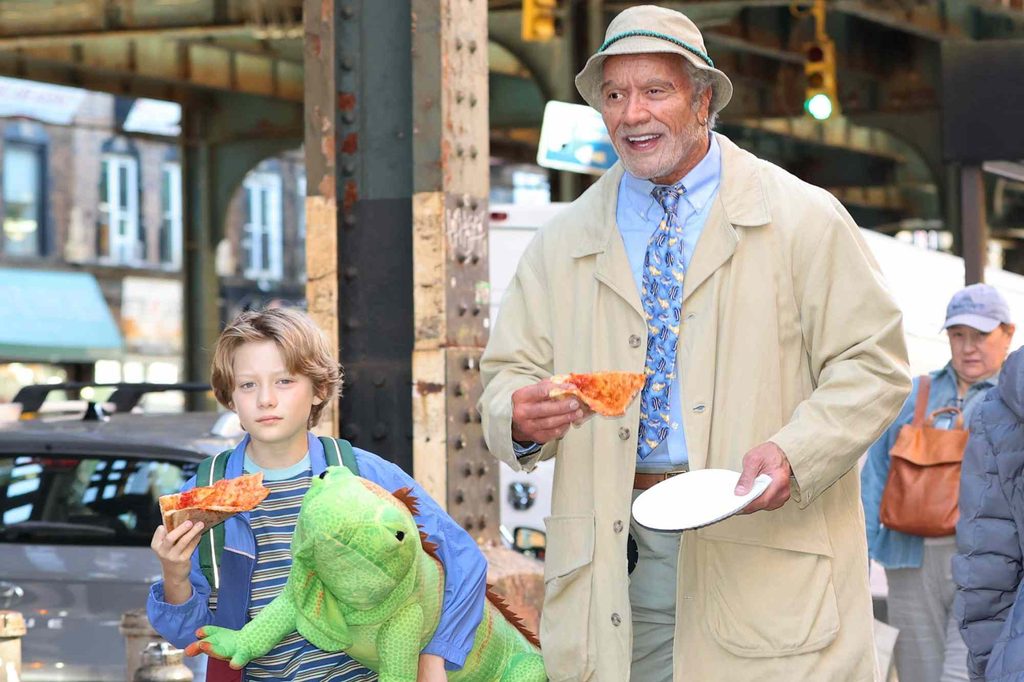
Photographs emerging from the active New York City production of Lizard Music captured an image so thoroughly disorienting, so radically unmoored from popular culture’s collective memory, that casual social media scrollers initially presumed they were viewing an elaborate artificial-intelligence fabrication. Strolling between production trailers was a hunched, remarkably slender, weathered septuagenarian gentleman wearing a faded khaki bucket hat over wispy, disheveled gray-white hair. Beneath the rim of the hat, deep crow’s-feet, sagged jowls, delicate liver spots, and rough silver stubble mapped the topographical reality of a man in his eighth decade of life. Draped in an oversized, slightly rumpled tan trench coat over a blue button-down shirt, a dated geometric necktie, baggy olive-green slacks, and orthopedically sensible gray walking sneakers, the figure looked less like the highest-paid action star on planet Earth and more like a retired midwestern librarian wandering toward a neighborhood park bench.
Only the intense, soulful focus behind the eyes betrayed the reality: beneath the layers of silicone, latex, and muted wool stood Dwayne Johnson, completely unrecognizable at fifty-four years of age.
The scene unfolding on the Manhattan set was a marvel of covert cinematic immersion. Steam billowed from nearby subway grates, street vendors pushed pretzel carts beneath flickering neon diner signs, and flocks of urban pigeons gathered near the curb—yet pedestrians walking down the block casually brushed past one of the most famous men on Earth without the slightest flicker of recognition. Veteran paparazzi who had staked out the filming location expecting to snap pictures of Johnson’s trademark physique were left bewildered, only realizing they were pointing long lenses at the superstar when director Benny Safdie called ‘cut’ and the stooped elderly man warmly embraced his young co-star, Theo Clark Leber, with a hearty, familiar laugh.
Crew members on set marveled at Johnson’s profound commitment to staying inside the sensory world of the character. Arriving at the production base camp at 4:30 AM long before the Manhattan sunrise, Johnson spent his quiet pre-dawn hours listening to archival recordings of 1940s delta blues and early modal jazz, allowing the slow, contemplative rhythm of the music to settle his central nervous system into the Chicken Man’s gentle, unhurried mindset. Between complex camera setups, Johnson would quietly sit on apple boxes near local Lower East Side bodegas, sipping green tea and engaging in quiet, unhurried conversations with neighborhood shopkeepers who had no inkling that the kindly, soft-spoken senior citizen discussing pigeon migration patterns was the global titan of WWE and Hollywood box-office history.
The shockwaves radiating across the entertainment landscape were immediate and seismic. For millions of fans who have tracked Johnson’s daily 4:00 AM ‘Iron Paradise’ workouts—regimens featuring five-thousand-calorie daily meal plans and hundreds of pounds of iron plates—the physical transformation was nothing short of miraculous. Johnson had not merely worn a costume; he had fundamentally reorganized his physical vessel. In preparation for the role, Johnson undertook a rigorous somatic conditioning program, drastically reducing his heavy compound lifting volume, prioritizing cardiovascular endurance and fasting protocols to slim down his dense frame, and working extensively with movement coaches to inhabit the slow, deliberate, slightly unsteady cadence of an elderly man who has walked thousands of miles in worn shoes. His shoulders were visibly dropped and rounded; his famously broad chest and hulking traps had been suppressed into a modest, grandfatherly carriage; and his entire posture radiated a gentle, fragile vulnerability that seemed to belong to an entirely different biological entity.
The role commanding this breathtaking physical surrender is that of the ‘Chicken Man’—the whimsical, enigmatic, and endlessly fascinating elder protagonist of Daniel Pinkwater’s cult 1976 children’s fantasy novel Lizard Music. When Johnson first teased the project during an electric late-summer appearance at the Toronto International Film Festival, industry observers assumed he was speaking in metaphor when he mentioned ‘slimming down’ for an eccentric character study. The set photos confirmed that Johnson had approached the task with radical, uncompromising seriousness. He had shed substantial muscle mass, adjusted his gait to embody the deliberate, careful rhythm of an elderly wanderer, and surrendered the vanity that typically binds A-list movie stars to their youthful images.
To witness Dwayne Johnson voluntarily strip away the armor of ‘The Rock’ is to witness a profound historical inflection point in modern movie stardom. In an era when Hollywood megastars routinely cling to digital de-aging, flattering camera filters, and repetitive superhero tropes well into their sixties, Johnson’s decision to embrace aged frailty, eccentricity, and quiet mystery signals a daring artistic renaissance. The Chicken Man has arrived, and in doing so, he has officially buried the invincible myth of The Rock beneath the asphalt of New York City.
2. The Masterstroke of Kazu Hiro: The Alchemy of Prosthetic Aging and Physical De-Heroization
Behind every transformative landmark in cinematic history lies an alchemist of flesh and shadow—a prosthetic visionary capable of bridging the chasm between an actor’s known anatomy and the interior soul of their character. In the case of Dwayne Johnson’s astonishing metamorphosis in Lizard Music, that alchemist is the undisputed contemporary maestro of special effects makeup: two-time Academy Award winner Kazu Hiro.
Hiro’s resume reads like a sacred canon of modern cinematic illusion. It was Hiro who performed the jaw-dropping sorcery that vanished Gary Oldman beneath the jowls, cigar smoke, and historic weight of Winston Churchill in Joe Wright’s Darkest Hour, earning him his first Oscar. It was Hiro who meticulously resculpted Charlize Theron’s facial cartilage and bone structure to mirror news anchor Megyn Kelly in Bombshell, securing his second golden statuette. More recently, Hiro captured global critical rapture for his breathtaking, multi-decade transformation of Bradley Cooper in Maestro, tracing the conductor Leonard Bernstein from vibrant youth to agonizing, weathered old age with photographic veracity.
Yet transforming Dwayne Johnson presented Hiro with what may well be the most technically daunting challenge of his storied four-decade career. When an artist is tasked with aging an everyday character actor, they work with a relatively malleable canvas. But Dwayne Johnson is not an everyday character actor; he is an anatomical monolith. His skull structure, jawline, neck circumference, and muscular density are burned into the retinas of billions of people across the globe. To simply slap prosthetic latex over Johnson’s jaw would have produced a grotesque, distracting caricature—the cinematic equivalent of putting a novelty mask on a mountain.
Instead, Hiro engaged in an exhaustive, months-long process of digital photogrammetry, anatomical 3D modeling, and handcrafted silicone sculpture that dismantled Johnson’s face from the bone outward. Working out of his private studio, Hiro cast precise impressions of Johnson’s head, studying the exact vector where facial muscles interact with emotional expression. Rather than adding bulk to an already massive individual, Hiro performed an optical miracle: using subtle shadowing, translucent silicone pigmentation, and counter-intuitive dermal blending to make Johnson’s face appear softer, thinner, and visibly depleted by seven decades of life.
Every morning in the production’s specialized makeup trailer, Johnson endured a painstaking three-and-a-half-hour application process. Hiro utilized a proprietary platinum-cure medical silicone formulated with varying densities to mimic the differing textures of human tissue—softer and more pliant along the neck and sagging jowls, firmer over the cheekbones and brow. The appliances were painted using micro-stippling techniques, applying dozens of microscopic layers of semi-translucent skin-tone pigments, broken capillaries, and delicate age spots that respond to shifting natural daylight exactly like real, aged human skin.
Hiro worked in intimate tandem with acclaimed costume designer Miyako Bellizzi (famed for her gritty, hyper-authentic sartorial world-building in Uncut Gems). Together, they calibrated the textures and drape of the Chicken Man’s wardrobe to harmonize with the prosthetic skin tones. The muted earth tones of the oversized trench coat and olive trousers were intentionally tailored with softened, sloped shoulder seams and dropped armholes, visually concealing Johnson’s massive lats and traps while allowing the wrinkled, fragile silicone neck appliances to flow naturally into the rumpled collar.
Furthermore, Hiro and his dental technicians created subtle custom acrylic dental veneers that slightly aged Johnson’s teeth, softening his blinding celebrity smile and gently altering the cadence of his speech to reflect the soft-spoken, whimsical mannerisms of the Chicken Man. Individual strands of real gray, white, and salt-and-pepper hair were punched by hand into the custom lace wig and facial stubble pieces, mimicking the thinning, irregular growth patterns characteristic of septuagenarian men.
Equally brilliant was Hiro’s work on Johnson’s hands and neck. In cinematic transformations, the hands are notoriously the ultimate giveaway; a youthful, veiny, muscular hand protruding from the sleeve of an elderly man’s coat instantly shatters the theatrical illusion. Hiro designed intricate silicone back-hand appliances that introduced delicate paper-thin skin, softened knuckles, faded sunspots, and subtle tremor patterns, completing the illusion down to Johnson’s fingertips.
In an industry currently obsessed with digital de-aging and computer-generated visual effects—technologies that often plunge films into the soulless uncanny valley, as seen in projects like The Irishman—Hiro’s tactile, in-camera practical prosthetics stand as a triumphant testament to human craftsmanship. When light hits Johnson’s weathered face on 35mm film, there are no digital artifacts, no smoothing filters, and no uncanny dead-eyed glaze; there is only the authentic, breathing reality of age.
This collaboration marks the second historic convergence between Johnson and Hiro. Earlier in the year, the duo worked in absolute secrecy to craft the bruised, cauliflower-eared, raw prosthetics that enabled Johnson to portray UFC trailblazer Mark Kerr in Benny Safdie’s highly anticipated A24 biopic The Smashing Machine. Yet where The Smashing Machine required Hiro to enhance Johnson’s brutal, tragic physicality, Lizard Music demanded the exact opposite: an act of total physical de-heroization.
Under Hiro’s masterly touch, the transformation ceases to be an ostentatious technical stunt; it becomes a sacred vessel of empathy. The silicone does not hide Dwayne Johnson; it liberates him. Stripped of the crushing obligation to look handsome, invincible, and market-ready, Johnson is granted the ultimate artistic gift: the total anonymity required to inhabit the gentle, mysterious soul of Daniel Pinkwater’s legendary elder.
3. The Safdie Connection: Why Auteur Collaboration Is Dwayne Johnson’s True Renaissance
To fully comprehend how Dwayne Johnson arrived at the improbable station of playing an eccentric, chicken-loving septuagenarian wandering through a surrealist fantasy about jazz-playing reptiles, one must trace the catalytic influence of the filmmaker steering the ship: director, screenwriter, and cinema provocateur Benny Safdie.
Alongside his brother Josh, Benny Safdie spent the 2010s establishing himself as one of the most vital, daring, and formally exhilarating voices in contemporary American independent cinema. Through relentless, panic-inducing urban masterworks like Good Time and Uncut Gems, the Safdies demonstrated an unprecedented genius for stripping established Hollywood movie stars of their polished armor and plunging them into the frantic, sweat-soaked crucible of moral desperation. In Good Time, they took Robert Pattinson—then widely stereotyped as a brooding teen-heartthrob vampire—and extracted a raw, feral, career-defining performance as a desperate Queens bank robber. In Uncut Gems, they took Adam Sandler—a comedian long pigeonholed by low-effort studio farces—and guided him to a tour-de-force dramatic performance as manic diamond dealer Howard Ratner that earned universal critical acclaim and permanently reshaped the cultural perception of his dramatic range.
When Benny Safdie embarked on his solo directorial journey following the brothers’ amicable creative pause, many assumed he would seek out another scrappy indie darling or brooding art-house icon. Instead, Safdie set his sights on the most commercial, heavily branded, and unlikely target in the entire Hollywood ecosystem: Dwayne Johnson.
The partnership began with The Smashing Machine, the gritty A24 drama chronicling the harrowing rise, steroid addiction, and personal unraveling of mixed-martial-arts pioneer Mark Kerr during the no-holds-barred era of the late 1990s. Safdie saw in Johnson something that decades of focus-grouped studio executives had systematically ignored: an immense reservoir of untapped, deeply vulnerable emotional truth buried beneath the wrestler’s persona. During the grueling production of The Smashing Machine, an extraordinary creative kinship was forged. Safdie pushed Johnson to emotional depths he had never previously dared to explore, forcing him to abandon his defensive charisma and confront themes of physical decay, addiction, and emotional shame.
It was during the final days of wrapping The Smashing Machine that the seeds of Lizard Music were planted. As Johnson recounted to a spellbound audience at the Toronto International Film Festival: ‘Benny pitched me this after we wrapped The Smashing Machine. And after about forty-five minutes, his pitch ended, and I looked at him and said, “I am your Chicken Man.” Now what that means is, without giving too much away, the role that I will play is a very whimsical and eccentric seventy-something-year-old man called the Chicken Man, and his best friend is a seventy-something-year-old chicken.’
Safdie’s directorial genius lies in his signature sensory realism. Born and raised in New York City, Safdie possesses an intimate, encyclopedic love for the eccentric, overlooked human beings who populate the city’s sidewalks—the street philosophers, the oddball collectors, the quiet loners who march to the beat of their own invisible rhythms. Rather than treating Daniel Pinkwater’s novel as a glossy, candy-colored Hollywood fantasy in the vein of a Disney live-action remake, Safdie is shooting Lizard Music with gritty 1970s celluloid textures, utilizing natural street noise, overlapping audio tracks, and real urban locations to ground the surrealism in tactile reality.
What makes Safdie’s approach to Johnson so revolutionary is that Safdie does not view Johnson as a franchise asset to be exploited, but as a magnificent, clay-like dramatic instrument to be sculpted. Safdie possesses a deep, intuitive understanding of contrast. He recognizes that there is nothing more electrifying in modern cinema than taking a cultural titan known for immense power and placing him in a world of tender, absurd, and fragile magic. On set, Safdie creates an atmosphere of radical psychological safety, encouraging Johnson to improvise, to stumble, to speak softly, and to shed the polished cadence of a public speaker.
For Johnson, entering Safdie’s creative orbit represents an act of profound artistic courage. For over a decade, Johnson operated within a heavily fortified corporate bubble, producing projects through his own Seven Bucks banner that prioritized global box-office metrics, consumer brand partnerships, and algorithmically optimized story beats. The catastrophic critical and financial fallout of 2022’s Black Adam—a project intended to reshape the hierarchy of the DC superhero universe that instead resulted in corporate embarrassment and franchise cancellation—served as a profound existential wake-up call. Johnson recognized that the endless pursuit of corporate scale had led him into an artistic dead end.
By submitting unconditionally to Benny Safdie’s idiosyncratic, uncompromising vision across two consecutive wildly different projects, Johnson has embarked upon his own version of the ‘McConaissance.’ He has traded the safe, predictable certainty of multi-picture corporate sequels for the high-wire thrill of auteur cinema. In the hands of Benny Safdie, Dwayne Johnson is no longer an action figure collecting royalty checks; he is an artist rediscovering the joyful, terrifying thrill of true creation.
4. Whimsical Surrealism and Midnight Radios: Unpacking Daniel Pinkwater’s Cult Masterpiece
To understand why Lizard Music is poised to become one of the most singularly enchanting, bizarre, and visually audacious cinematic events of the decade, one must delve into the literary source material that birthed it: the boundless, delightfully unhinged imagination of author Daniel Pinkwater.
Published in 1976 and adorned with Pinkwater’s own quirky, woodcut-style illustrations, Lizard Music has long occupied a sacred, beloved pedestal within the realm of surrealist children’s literature. Unlike conventional juvenile fiction that patronizes young readers with heavy-handed moral lessons or antiseptic fairy-tale tropes, Pinkwater’s work treats childhood as an ecstatic, slightly melancholic mystery—a time when the everyday world is full of secret doors, forgotten wavelengths, and magical absurdities that adults are simply too hurried, boring, and self-important to perceive. For decades, Pinkwater was celebrated by listeners of National Public Radio’s All Things Considered for his gravelly, whimsical commentary, championing the strange, the wonderful, and the beautifully eccentric corners of the human experience.
The narrative follows Victor Wing, a fiercely independent, intelligent young boy whose parents and older sister embark on a two-week summer vacation, leaving him home alone with an envelope of grocery money and an unmonitored television set. Left to his own devices, Victor spends his sweltering summer evenings feasting on frozen pizzas, drinking soda, and staying up until the surreal twilight hours of 3:00 AM, mesmerized by the strange test patterns, foreign broadcasts, and bizarre programming flickering across his cathode-ray tube screen.
One fateful midnight, as the local television stations sign off with the national anthem and static, Victor’s television screen suddenly crackles to life with an unscheduled, pirate broadcast from an unknown frequency. What Victor witnesses changes his life forever: a sublime, impeccably dressed band of upright, human-sized lizards wearing elegant suits and bowties, performing the most complex, soulful, and hypnotic jazz music he has ever heard in his life. The lizards play saxophones, upright basses, and trumpets with virtuoso grace, communicating a profound, otherworldly joy that leaves the young boy utterly spellbound. The music is not commercial cartoon jazz; it is sophisticated, avant-garde, bebop-infused poetry inspired by the genius of Thelonious Monk, Charlie Parker, and Sun Ra.
Determined to discover whether these musical reptiles are a localized broadcast hallucination, an elaborate practical joke, or a real-world wonder, Victor sets out on an investigative odyssey through his eccentric city. His quest leads him into the orbit of the most enigmatic figure in the metropolitan underworld: the Chicken Man.
In Pinkwater’s novel, the Chicken Man is a walking zen riddle. He is an elderly, gentle gentleman who lives on the invisible fringes of urban society, possessing a profound, secret communion with the hidden wonders of the world. Tucked beneath his arm or perched calmly atop his head is his constant companion, soulmate, and intellectual equal: Claudia, an ancient, fiercely intelligent, seventy-something-year-old hen who communicates with him through subtle clucks, head tilts, and telepathic understanding. To bring Claudia to life on screen, Safdie and his practical effects department rejected total reliance on computer-generated imagery, instead engineering a marvelous hybrid of highly trained live heritage hens and an extraordinarily detailed practical animatronic puppet supervised by master puppeteers, allowing Johnson to interact with genuine physical presence and comedic nuance.
Together, the Chicken Man and Claudia act as Victor’s guides, escorting him aboard an invisible ferry to the legendary ‘Pod Island’—a floating, utopian sanctuary in the middle of Lake Michigan inhabited entirely by civilized, jazz-playing lizards who have established an enlightened society free from the greed, pollution, and neuroses of humankind.
Translating this delicate, poetic, and whimsical tapestry to the big screen requires an ensemble cast capable of balancing deadpan absurdity with genuine, grounded heart. Benny Safdie has assembled a jaw-dropping roster of talent that mirrors the eclectic spirit of the book. Starring alongside Johnson as young Victor is rising child prodigy Theo Clark Leber, whose wide-eyed naturalism anchors the film’s sense of wonder. The live-action cast is rounded out by alternative comedy titan Tim Heidecker (On Cinema at the Cinema), 1990s icon Alicia Silverstone (Clueless), and comedy royalty Regina Hall (Girls Trip).
Equally astonishing is the film’s voice cast, which brings the aristocratic, saxophone-wielding lizards of Pod Island to vivid acoustic life. Academy Award nominee Colman Domingo (Rustin, Sing Sing) lends his rich, velvet baritone to the leader of the lizard ensemble, joined by Oscar nominee Rachel McAdams as the group’s sultry lizard chanteuse, the legendary Jeff Goldblum (whose idiosyncratic vocal jazz cadences are practically tailor-made for a civilized musical gecko), and character actor extraordinaire David Krumholtz (Oppenheimer).
In an era saturated with grim, dystopian sci-fi and cynical blockbuster reboots, Lizard Music offers an antidote of pure, undiluted joy. It is a love letter to childhood independence, late-night curiosity, jazz music, and the magical realization that the universe is far stranger, kinder, and more magnificent than we were ever led to believe.
5. The Architecture of Reinvention: What Chicken Man Means for the Future of Megastar Cinema
The sight of Dwayne Johnson shuffling down a New York street in an oversized trench coat, sporting liver spots and a bucket hat, carries an importance that extends far beyond the production notes of a single holiday movie. It represents a profound, fascinating case study in the sociology of modern Hollywood celebrity—and perhaps the opening salvo in a radical restructuring of what it means to be a global movie star in the post-franchise era.
For the past twenty years, the traditional movie star has been systematically marginalized by corporate Hollywood. In the Golden Age of the studio system, audiences bought tickets to see Humphrey Bogart, Bette Davis, Cary Grant, or Katharine Hepburn. In the 1980s and 1990s, stars like Arnold Schwarzenegger, Tom Cruise, Julia Roberts, and Will Smith were self-contained intellectual properties whose names above the title guaranteed hundred-million-dollar box-office grosses regardless of the underlying premise.
However, the dawn of the comic-book cinematic universe and algorithmic streaming platforms dismantled that dynamic. Studios spent two decades teaching audiences to care about the IP rather than the actor. Fans rushed to theaters to see Spider-Man, Batman, Iron Man, or Barbie; the individual human being inhabiting the costume was increasingly treated as an interchangeable, disposable cog in a corporate marketing machine.
Dwayne Johnson was the rare, singular exception who managed to defy that trend. Through sheer, unrelenting work ethic, unparalleled social-media mastery, and an intuitive understanding of global populist entertainment, Johnson became the last true traditional movie star standing. Between 2011 and 2021, Johnson was not merely an actor in hit movies; he was a human brand whose personal endorsement could transform obscure 1980s video games (Rampage) or vintage board games (Jumanji) into billion-dollar franchises.
Yet that very success created a suffocating creative prison. When an actor’s personal brand becomes that massive, that financially interdependent with beverage companies, fitness apparel lines, tequila distilleries, and theme park attractions, the space for artistic risk-taking shrinks to zero. Johnson became trapped in a feedback loop of his own making, forced to play variations of ‘The Rock’—the hyper-competent, smirking, invincible alpha male—again and again until the formula finally curdled into creative exhaustion.
History teaches us that the only way for a megastar of that magnitude to survive into late-career relevance is through the deliberate, courageous destruction of their own persona. We saw it when Clint Eastwood moved past the stoic machismo of the Man with No Name and Dirty Harry to direct and star in Unforgiven and Gran Torino, deconstructing his own violent mythology. We saw it when Sylvester Stallone set aside Rambo to gain weight and embody weary, vulnerable dignity in Cop Land and Creed. We saw it when Tom Cruise walked away from his dashing leading-man vanity to dance in a fat suit as foul-mouthed studio mogul Les Grossman in Tropic Thunder. We saw it when Matthew McConaughey abandoned million-dollar romantic comedies to lose fifty pounds for Dallas Buyers Club and plunge into existential nihilism in True Detective.
With Lizard Music and The Smashing Machine, Dwayne Johnson is executing his own radical deconstruction. By embracing the Chicken Man, Johnson is sending an unmistakable message to the film industry and to audiences worldwide: he is no longer interested in playing it safe. He is willing to look fragile. He is willing to look old. He is willing to look ridiculous, gentle, and absurd. He is prioritizing legacy over quarterly earnings.
Set for a prestigious theatrical release on Christmas Day 2027 by Amazon MGM Studios, Lizard Music arrives at the exact moment audiences are starving for genuine cinematic magic. Interestingly, exactly one year prior to Lizard Music’s debut, Johnson will headline Jumanji: Open World for Christmas 2026—delivering the expected four-quadrant blockbuster spectacle for family crowds. But by pairing that massive commercial obligation with the auteur brilliance of Benny Safdie and Daniel Pinkwater, Johnson has constructed the ultimate career equilibrium.
The Rock has stepped aside so that Dwayne Johnson, the actor, can finally take flight. And as he walks down the streets of New York with an ancient chicken perched upon his arm, listening for the faint, midnight strains of lizard jazz floating across the airwaves, one thing is abundantly clear: we are witnessing the birth of a brand-new legend.
From: Bhgiftnest

