
Movies, TV News
Reptiles, Opulence, and Toad Venom: Inside Billy Porter’s Radical Debut as Magno Stift in The Hunger Games: Sunrise on the Reaping
Oct
1. The Apathetic Artisan: Deconstructing Billy Porter’s Introduction to Panem’s Dystopian Runway
In the gilded, grotesque corridors of the Capitol of Panem, fashion has never been a mere aesthetic indulgence or an innocent display of personal expression; it is an instrument of state terror, an ideological weapon, and the glittering veneer plastered over the ritualized slaughter of children. For over a decade, fans of Suzanne Collins’ globally celebrated dystopian saga have understood that the clothes worn by tributes upon their arrival in the Capitol determine their visibility, their sponsorship revenues, and ultimately their survival in the arena. Yet, when Lionsgate officially unveiled the first exclusive look at Emmy, Tony, and Grammy-winning visionary Billy Porter as District 12 stylist Magno Stift in the eagerly anticipated prequel The Hunger Games: Sunrise on the Reaping, the franchise introduced an entirely new, subversively dark archetype to its cinematic lore: the apathetic, spiritually broken artisan who has completely checked out from the horrifying machinery of state entertainment.
Billy Porter, universally revered across the global pop-culture landscape for his groundbreaking sartorial statements, his red-carpet metamorphic triumphs, and his searing dramatic performances in seminal works like Ryan Murphy’s Pose, would seem on paper to be the most natural addition imaginable to the hyper-stylized world of Panem. Yet the actor’s journey into the brutal heart of the franchise was anything but conventional. As Porter candidly admitted in an exclusive interview with Entertainment Weekly, he had spent years actively avoiding the dystopian series. ‘I’m gonna be honest with you: I tried to watch the first Hunger Games movie four times; I didn’t understand it,’ Porter revealed with characteristic candor. ‘It was too violent.’ For an artist whose career has been anchored in celebrations of human dignity, liberation, and ballroom community resilience, the relentless, blood-drenched spectacle of adolescents forced into lethal gladiatorial combat initially felt repulsive rather than entertaining.
The catalyst that fundamentally transformed Porter’s perspective came in the form of a direct, passionate personal summons from veteran franchise producer Nina Jacobson. Having developed a profound professional respect for Porter through their mutual connections within the high-prestige television circuit and the creative orbit of Ryan Murphy, Jacobson recognized that the character of Magno Stift required far more than superficial flamboyant flair; it demanded an actor capable of projecting centuries of layered, tragic theatricality, soul-weary resignation, and hidden moral torment beneath a dazzling exterior. When Jacobson laid out the philosophical architecture of Suzanne Collins’ upcoming novel and Billy Ray’s screenplay, Porter finally consented to revisit the material through an analytical, literary lens. The realization hit him with sudden clarity: The Hunger Games was not an exploitation of violence, but a profound, razor-sharp anti-fascist allegory.
Porter found himself drawing immediate, illuminating connections between Collins’ Panem and the classical socio-political allegories that had shaped his intellectual upbringing, specifically citing George Orwell’s Animal Farm and William Golding’s Lord of the Flies. ‘[These] books are about humanity and teaching children, through art, the difference between good and evil,’ Porter explained to EW. Recognizing that the franchise operated as a crucial moral mirror reflecting modern society’s voyeuristic appetite for media sensationalism, imperial hubris, and authoritarian subjugation, Porter eagerly signed on to make Sunrise on the Reaping what he affectionately christened ‘Daddy’s first franchise.’
Stepping into the fabulous, snakeskin-clad boots of Magno Stift represents a radical, intentional inversion of the stylist archetype previously established in the franchise. When audiences first entered District 12’s styling chambers alongside Katniss Everdeen in the 2012 original film, they were greeted by Cinna, immortalized with quiet, revolutionary warmth by Lenny Kravitz. Cinna was an authorial conspirator, an empathetic guardian angel, and a subversive political saboteur who weaponized fashion to spark a revolution, transforming Katniss into ‘The Girl on Fire’ through synthetic flames and mockingjay motifs that challenged President Snow’s absolute dominion. Cinna loved his tributes, mourned their suffering, and willingly laid down his life so that District 12 might rise from the ashes.
Magno Stift, presiding over District 12’s tributes twenty-four years earlier during the fateful 50th Hunger Games (the Second Quarter Quell), exists at the exact polar opposite of Cinna’s heroic trajectory. Rather than an idealistic revolutionary plotting the downfall of tyranny, Magno is a washed-up, deeply cynical Capitol functionary who has long since abandoned any pretense of care or artistic ambition. Tasked with outfitting District 12’s doomed youth, Magno approaches his assignment not with defiant inspiration, but with crushing indifference. ‘He isn’t doing his job very well,’ Porter openly acknowledged. ‘He feels a little apathetic.’
Yet to dismiss Magno Stift as merely incompetent or casually sadistic would be to fundamentally misunderstand the profound psychological defense mechanisms that govern life within a totalitarian regime. Porter crafted an intricate, devastating internal backstory for the stylist, viewing his apathy not as inherent cruelty, but as the scarred residue of a moral conscience that had been broken beyond repair. ‘The backstory I gave myself is that his humanity kicked in and he’s not happy with what the Capitol does to these children. Actually, he’s really horrified by it, but he can’t get out of it,’ Porter explained. ‘But what he can do is get high and detach.’ In Magno Stift, Sunrise on the Reaping provides a haunting examination of the bystander’s complicity: the gifted artist who sees the horror, recognizes the monstrosity of the system he serves, yet possesses neither the suicidal courage of a martyr nor the cold-blooded enthusiasm of an executioner, choosing instead to drown his agony in chemical oblivion and detached cynicism.
2. Capitol Decadence and Chemical Escape: The Psychology of Toad Venom and Snakewear Couture
To truly inhabit the psychological bunker of a Capitol citizen who has witnessed decades of annual slaughter without the luxury of delusion, Steven Soderbergh’s cinematic descendants in the dystopian arena must navigate a delicate balance of physical extravagance and internal decay. In Sunrise on the Reaping, Magno Stift’s primary survival mechanism is as exotic and poisonous as the high-society circles he navigates: an unabashed, constant addiction to toad venom. In the lavish dressing suites of the Tribute Center, while terrified children weep for their families, Magno is actively micro-dosing hallucinogenic secretions, maintaining a blissfully detached state of chemical numbness that isolates him from the screams echoing through Panem’s television broadcasts.
This deliberate state of dissociation renders Magno virtually blind to the individuality of the four District 12 tributes assigned to his care for the monumental Second Quarter Quell: sixteen-year-old Haymitch Abernathy (portrayed with smoldering, dangerous intensity by rising Australian actor Joseph Zada), the fiercely intelligent and observant Maysilee Donner (played by Mckenna Grace), the frightened young Louella McCoy (Molly McCann), and the stoic Wyatt Callow (Ben Wang). In the brutal ceremonial countdown leading up to the arena gates, fashion is quite literally a matter of life and death. The televised Chariot Parade along the Avenue of the Tributes and the prime-time interviews conducted by the flamboyant, newly minted broadcast host Caesar Flickerman (played with manic, sociopathic charm by Succession star Kieran Culkin) represent the tributes’ sole opportunity to capture the fickle affection of Capitol sponsors who can parachute crucial medicine, food, and weaponry into the arena.
Under Magno Stift’s negligent stewardship, however, District 12 is systematically denied this vital lifeline. Having earned a notorious reputation throughout the Capitol’s styling guilds for his stubborn, lazy refusal to innovate, Magno infamously recycles the exact same uninspired, soot-covered coal-miner jumpsuits year after year. Rather than crafting custom, breathtaking ensembles that accentuate the unique personalities or physical strengths of his tributes, he shoves Haymitch, Maysilee, Louella, and Wyatt into generic, drab workwear that makes them the laughingstock of the Capitol press corps. This sartorial neglect gives the arrogant Career tributes from Districts 1, 2, and 4 yet another pretext to dismiss District 12 as disposable cannon fodder, effectively painting bullseyes on their backs before the opening gong even sounds.
Yet Porter’s nuanced characterization reveals that this repetitive styling choice carries a subtle, subversive undercurrent. By refusing to dress these children up as exotic delicacies for Capitol amusement, Magno unintentionally strips away the romanticized glamor of the games, exposing the raw, ugly truth of District 12’s enslaved labor force. Magno cannot bring himself to invest creative energy into garments that will merely be drenched in blood forty-eight hours later. As Porter poignantly reflected: ‘He’s already been affected by years and years and years past. I don’t even really feel like he even sees these tributes. He can’t even take it in. That’s the version that I was playing.’ To acknowledge their humanity, to learn their names, or to design masterpieces that flatter their youthful beauty would be an act of emotional self-immolation; detachment is the only armor that keeps his fragile psyche from shattering.
While Magno Stift cannot be bothered to expend effort on his doomed teenage charges, he maintains an obsessive, unapologetic dedication to his own personal aesthetic. In the Capitol, vanity is an indelible civic religion, and even a thoroughly washed-up stylist refuses to relinquish his peacock feathers. ‘The sense of style never goes away, let’s be real,’ Porter laughed during his EW discussion. ‘He’s not gonna look like a bag lady. It’s how he engages in that world. And he has taken himself out of engaging in that world, [but] he still looks good doing it. Make no mistake.’
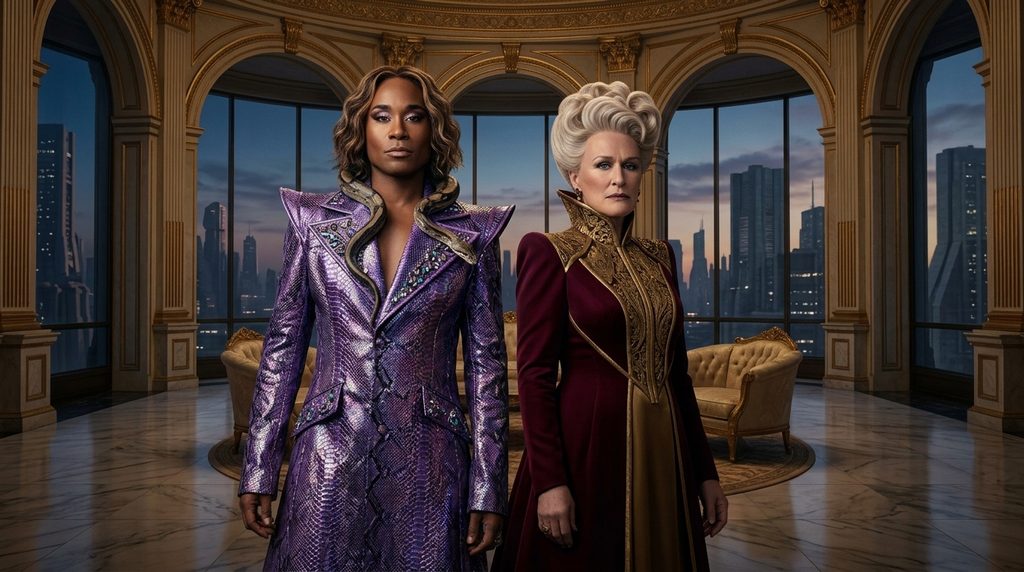
The visual manifestation of Magno’s personality on screen is an awe-inspiring tour de force of dystopian high fashion. Porter revealed that the production’s costume and hair departments were ‘hellbent’ on crowning him with an ultra-sleek, luxurious, floor-length wig—a hairstyle the Tony-winner jokingly noted he recently learned the internet refers to as a ‘buss down.’ Yet the crown jewel of Magno’s wardrobe is an astonishing, custom-tailored purple snakeskin trench coat, shimmering with iridescent violet and emerald scales that evoke the predatory elegance of a venomous serpent basking under studio floodlights.
The reptilian motif is not merely an eccentric fashion statement; it serves as the defining thematic metaphor for Magno’s character and his place within Panem’s food chain. In a chilling behind-the-scenes revelation, Porter confirmed that director Francis Lawrence insisted that Magno accessorize with an actual, live serpent during several key sequences in the Capitol. For Porter, handling a live exotic snake on set was an intensely visceral, nerve-wracking challenge. ‘Terrifying,’ Porter admitted, though he noted with pride that professional discipline ultimately won out. ‘I’m not gonna have a pet snake or nothing like that, but I did bond with my snake, yes.’
The presence of the serpent wrapped around Porter’s neck creates a chilling visual resonance with the broader mythology of The Hunger Games. Snakes have long served as the ultimate heraldic symbol of the Capitol’s cold-blooded ruthlessness, most vividly crystallized in the persona of Coriolanus Snow and the genetically engineered muttations engineered by Dr. Volumnia Gaul in The Ballad of Songbirds and Snakes. By draping himself in living reptiles, Magno physically manifests the cold, unfeeling detachment required to navigate Capitol aristocracy. He has transformed himself into a cold-blooded creature, slow to move, emotionally anesthetized by toad venom, and coiled defensively against the predators that surround him on all sides.
3. Scenery-Chewing Royalty: The Toxic Marriage of Magno Stift and Glenn Close’s Drusilla Sickle
While Billy Porter’s reptilian companion provided an undeniably unforgettable physical dynamic on set, the actor’s most exhilarating, explosive creative collision occurred opposite an undisputed titan of modern stage and screen: eight-time Academy Award nominee Glenn Close. In Sunrise on the Reaping, Close portrays Drusilla Sickle, the formidable, razor-tongued Capitol escort assigned to shepherd District 12’s tributes through the social labyrinth of Panem’s high society. As the historical precursor to Elizabeth Banks’ iconic Effie Trinket, Drusilla represents the rigid, suffocating etiquette of an older, harsher Capitol era—a woman obsessed with social decorum, ancestral prestige, and the ruthless enforcement of protocol amidst unthinkable carnage.
The narrative dynamic established between Porter’s Magno Stift and Close’s Drusilla Sickle is as delicious as it is toxic. Unlike the platonic, uneasy camaraderie that eventually blossomed between Effie Trinket and Haymitch Abernathy decades later, Magno and Drusilla are bound together in the suffocating shackles of a catastrophic Capitol marriage. In the opulent, hollow high-society circles of Panem, marriages among the elite are frequently transactional arrangements designed to consolidate political influence, mask personal eccentricities, and present an unblemished facade of domestic perfection to the broadcast cameras. Behind closed doors, however, the union between District 12’s escort and stylist is an active war zone of mutual contempt.
Porter summarized their domestic discord with uproarious, unforgettable brevity in his EW interview: ‘We’re married, and we hate each other. That’s the bottom line. It’s not a happy marriage.’ Where Drusilla is rigid, calculating, and furiously determined to claw her way up the social ladder of the Capitol despite being saddled with the embarrassment of District 12, Magno is an unmotivated, perpetually stoned aesthetician who views her aristocratic pretensions with mocking disdain. Their verbal duels across the breakfast tables of the Tribute Center crackle with razor-sharp venom, as Drusilla berates Magno for humiliating her with recycled coal-miner costumes while Magno lazily blows smoke rings and mocks her desperate sycophancy toward the Snow administration.
Off-camera, however, the relationship between the two performers was a masterclass in profound mutual adoration and joyous theatrical synergy. Porter has never hidden his lifelong reverence for Close, whose iconic portrayals of aristocratic monsters and tragic heroines in masterpieces like Dangerous Liaisons, Fatal Attraction, and Sunset Boulevard have served as foundational north stars for his own dramatic development. ‘I love Glenn Close,’ Porter beamed with unadulterated enthusiasm. ‘I wanna be her when I grow up.’
When two world-class theatrical powerhouses with deep roots on Broadway and the classical stage share a soundstage, the resulting energy is combustible. Porter and Close approached their scenes not with understated cinematic naturalism, but with the grand, operatic theatricality that the decadent world of the Capitol inherently demands. Porter gleefully described their collaborative process on set as an unapologetic, scorched-earth acting feast: ‘She comes to play and so do I. We chewed that scenery up. We chewed. They had to create a whole new budget to rebuild that scenery; there were no crumbs left, honey, none.’
This ferocious ‘scenery-chewing’ is precisely what makes the world of Panem’s ruling class so terrifyingly hypnotic on screen. The citizens of the Capitol do not perceive themselves as villains in a dystopian nightmare; they see themselves as glamorous protagonists in an eternal, glittering reality television extravaganza. By leaning into heightened melodrama, biting comedic barbs, and theatrical excess, Porter and Close provide a searing psychological portrait of imperial decay. Their bitter domestic sniping over floral arrangements and fabric swatches while sixteen-year-old tributes prepare to butcher one another in the arena underscores the monstrous banality of evil that lies at the core of Suzanne Collins’ socio-political critique.
Furthermore, the relationship between Drusilla Sickle and Magno Stift establishes the crucial historical scaffolding for the entire mentor-escort apparatus of District 12. As young Haymitch Abernathy endures the indignity of their toxic dynamic, he observes firsthand how the Capitol operates: not through monolithic, flawless efficiency, but through petty, self-absorbed bureaucrats consumed by personal grievances and chemical escapism. The cynical, sarcastic armor that Haymitch eventually adopts throughout his adult life—his own reliance on white liquor, his acerbic dismissals of Capitol etiquette, and his strategic manipulation of media expectations—was forged directly in the crucible of watching Magno Stift and Drusilla Sickle tear each other to shreds in the gilded salons of the 50th Hunger Games.
4. The 50th Hunger Games and the Second Quarter Quell: Haymitch Abernathy’s Crucible of Blood
To fully comprehend the stakes surrounding Magno Stift’s apathy and Drusilla Sickle’s manic social maneuvering, one must examine the monumental, catastrophic historical event at the heart of Sunrise on the Reaping: the 50th Annual Hunger Games, designated by the Capitol as the Second Quarter Quell. Every twenty-five years, in accordance with the cruel provisions established by the Treaty of Treason following the First Rebellion, the Capitol stages a Quarter Quell featuring a twisted, unprecedented rule modification designed to remind the enslaved districts that the Capitol’s power to punish is inexhaustible. For the 50th anniversary, the Capitol’s decree was as simple as it was apocalyptic: to demonstrate that two rebels died for every Capitol citizen lost during the uprising, each district was required to reap twice the usual number of tributes. Forty-eight children, rather than the standard twenty-four, were ripped from their families and thrust into the arena.
For District 12, an impoverished Appalachian mining colony that had produced only one living victor in half a century (the elderly, reclusive morphling addict Lucy Gray Baird having vanished into legend decades prior), the reaping was a devastating death sentence. It is into this nightmare that sixteen-year-old Haymitch Abernathy is cast. In Sunrise on the Reaping, Joseph Zada steps into the iconic role originally defined with Oscar-nominated brilliance by Woody Harrelson. Zada’s portrayal reveals a version of Haymitch that audiences have never seen: young, fierce, emotionally vibrant, and possessing an astonishing, razor-sharp tactical intellect that has not yet been submerged in decades of post-traumatic stress and alcoholic despair.
Haymitch is not alone in his condemnation. Among the four District 12 tributes reaped for the Second Quarter Quell is Maysilee Donner, brought to life by acclaimed actress Mckenna Grace. Long revered by book readers as one of the most tragic, consequential figures in Hunger Games lore, Maysilee is the childhood friend of Katniss Everdeen’s mother and the twin sister of Madge Undersee’s mother. It is Maysilee who originally owned the iconic gold Mockingjay pin—an artifact of defiant beauty that she carried into the arena, which would eventually travel across generations to rest on Katniss’s chest as the eternal emblem of the revolution. In the arena, Maysilee forms a fierce, protective alliance with Haymitch, utilizing her blowgun and deadly poison darts with surgical precision until her heartbreaking, agonizing demise at the beaks of genetically engineered, carnivorous pink candy-floss birds.
The ensemble cast assembled by director Francis Lawrence to populate this pivotal chapter of Panem history is arguably the most prestigious ever gathered for a genre blockbuster. Looming over the entire production is Academy Award nominee Ralph Fiennes as a middle-aged President Coriolanus Snow. Transitioning the character from Tom Blyth’s ambitious, desperate young academy student in The Ballad of Songbirds and Snakes toward Donald Sutherland’s chilling, autocratic patriarch in the original films, Fiennes portrays Snow at the absolute zenith of his tyrannical consolidation. Cold, calculating, and obsessed with systemic control, Snow views the 50th Games as a crucial test of his technological and psychological dominance over the districts.
Operating in Snow’s shadow is an electrifying wave of Capitol insiders and past victors whose decisions will reverberate across decades. Jesse Plemons delivers a masterclass in quiet, subterranean ambition as a younger Plutarch Heavensbee, planting the earliest, microscopic seeds of the underground conspiracy that will eventually culminate in the Mockingjay rebellion. Kieran Culkin brings his signature blend of charismatic bravura and poisonous cynicism to Caesar Flickerman, stepping into the broadcast shoes previously worn by his uncle Lucky Flickerman (Jason Schwartzman) to transform the execution of children into glittering prime-time entertainment. Meanwhile, past victors Beetee Latier (portrayed by Kelvin Harrison Jr.) and Wiress (played by Maya Hawke) hover on the periphery as traumatized, brilliant technicians whose revolutionary sparks are quietly rekindled by Haymitch’s audacious defiance in the arena.
The arena of the 50th Hunger Games itself remains one of Suzanne Collins’ most breathtaking, terrifying conceptual achievements: a deceptive, hyper-saturated paradise of intoxicating, lethal beauty. Designed by Capitol gamemakers to resemble a lush, idyllic meadow surrounded by snow-capped alpine peaks and crystalline babbling brooks, every single element of the environment is an engineered bio-weapon. The sparkling water is laced with lethal neurotoxins; the shimmering wildflowers emit paralyzing, asphyxiating perfumes; the adorable woodland creatures are flesh-eating predators; and the idyllic summer sky produces acidic, corrosive rainstorms that melt flesh upon contact.
It is in this sadistic garden that Haymitch Abernathy performs the singular act of defiance that cements his legendary status and seals his tragic fate. Discovering that the edge of the arena is bounded by a shimmering, forcefield cliff that hurls whatever touches it back into the playing field with lethal kinetic velocity, Haymitch outsmarts the final surviving Career tribute from District 1 by ducking beneath a hurled battle-ax, allowing the weapon to bounce off the forcefield and cleave his attacker in half. By turning the Capitol’s own technological architecture against them and exposing the artificiality of their arena on live television, Haymitch humiliates President Snow on a global broadcast. The victory secures his life, but it earns him the eternal, sadistic vengeance of the regime, resulting in the retaliatory murder of his mother, younger brother, and teenage sweetheart just two weeks after his return to District 12. It is this catastrophic trauma that ultimately transforms the vibrant young champion into the cynical, broken mentor who will one day greet Katniss and Peeta in the very same train cars where Magno Stift once drowned his sorrows in toad venom.
5. Dystopian Allegory and the Cinematic Expansion of Panem: Francis Lawrence’s Continuing Vision
The arrival of The Hunger Games: Sunrise on the Reaping, scheduled for a high-profile global theatrical and IMAX release on November 20, 2026, represents a rare, triumphant anomaly in the modern landscape of Hollywood intellectual property management. In an era where major studio franchises routinely collapse under the weight of uninspired corporate expansion, cynical spin-offs, and disjointed multiversal mechanics, Lionsgate’s stewardship of Suzanne Collins’ cinematic universe stands as a masterclass in authorial integrity, thematic continuity, and disciplined cinematic execution.
At the helm of this remarkable achievement once again is director Francis Lawrence, whose unbroken tenure as the visual and tonal architect of the franchise spans Catching Fire (widely regarded as one of the finest blockbuster sequels of the twenty-first century), Mockingjay Parts 1 & 2, and the critically acclaimed, commercially robust 2023 prequel The Ballad of Songbirds and Snakes. Lawrence’s directorial vision has never treated Panem as a lightweight young-adult playground; he approaches the material with the solemnity, visual density, and geopolitical gravity of a prestigious historical war epic. Working alongside Oscar-nominated screenwriter Billy Ray (who co-wrote the seminal 2012 original film) and Michael Lesslie, Lawrence has constructed a cinematic language that honors Collins’ intricate narrative prose while expanding the visual geography of Panem with breathtaking scale.
What elevates Sunrise on the Reaping far above conventional prequel territory is its urgent, unyielding socio-political relevance. Suzanne Collins has consistently utilized The Hunger Games not merely to deliver pulse-pounding survival thrillers, but to conduct rigorous, philosophical inquiries into the nature of propaganda, state-manufactured reality, media complicity, and the psychological mechanisms of authoritarian control. By exploring the concept of the ‘Second Quarter Quell,’ the narrative interrogates how totalitarian regimes utilize the illusion of doubled punishment and heightened spectacle to terrorize subjugated populations into submission while simultaneously entertaining a desensitized, voyeuristic public.
In this context, the casting of Billy Porter as Magno Stift ceases to be an eccentric novelty and emerges as an indispensable thematic linchpin. Porter represents the living embodiment of the Capitol’s moral rot: an exceptionally gifted artist who has compromised his soul to survive within a bloodthirsty empire. Magno is neither an unhinged sadist like the gamemakers nor a defiant freedom fighter like the underground rebels; he is the tragic, recognizable face of the everyday collaborator who chooses comfortable apathy and chemical escapism over the terrifying responsibility of moral courage. His purple snakeskin coats, his floor-length wigs, and his toad venom are the pathetic shields he raises to hide from his own reflection.
Furthermore, the cinematic dynamic between Porter’s Magno and Glenn Close’s Drusilla Sickle injects the film with a sharp, satirical edge that dissects the absurdity of imperial elitism. Their bitter domestic combat over fashion choices amidst the ritual slaughter of impoverished children serves as a scathing critique of modern celebrity culture and political distraction. In a world teetering on the edge of environmental catastrophe and democratic erosion, Collins and Lawrence remind audiences that when high society turns the suffering of the vulnerable into televised entertainment, civilization has already begun its irreversible collapse into the abyss.
As the production gears up for its definitive November 20, 2026 worldwide debut, anticipation within both the cinematic industry and the global fandom has reached a fever pitch. Sunrise on the Reaping promises not only to illuminate the tragic genesis of Haymitch Abernathy’s heroic cynicism, but to deepen the emotional resonance of the entire franchise, demonstrating how individual acts of survival, however compromised or broken, lay the invisible groundwork for eventual liberation. When Billy Porter steps onto the screen draped in serpents and velvet, audiences will witness a master actor delivering an unrepeatable masterclass in dystopian tragedy: an extravagant, heartbroken witness to the dawn of a rebellion that will eventually set the entire world on fire.
From: Bhgiftnest

